

What the Google March 2026 Core Update focused on
If you've been asking, What is Google March 2026 Core Update, the plain answer is simple. It was a broad ranking update, not a narrow penalty. Google adjusted how its core systems judge relevance, usefulness, and satisfaction across many queries, industries, and page types. According to the Google Search Status Dashboard, the rollout ended in 12 days and 4 hours, which was faster than many recent core updates. For a publisher-focused recap, see Google's March 2026 core update rollout timeline.
That matters because broad core updates do not work like a speeding ticket. They work more like a library re-shelving its books. Some pages rise because they fit the search better. Others drop because competing pages now look more useful, more trusted, or easier to understand.
Core updates usually don't punish one trick. They re-rank the shelf.
Why content quality mattered more than volume
Early Google March 2026 update ranking changes pointed to a familiar pattern. Pages with thin copy, repeated ideas, and little original value were more likely to lose ground. In contrast, pages with a clear purpose, first-hand examples, and stronger editorial review often held up better.
That does not mean Google rewarded length for its own sake. A shorter page could still perform well if it solved the searcher's problem. However, scaled publishing without clear value looked more exposed. Quantity alone rarely helps when many pages say the same thing in slightly different words.
How AI-written pages and trust signals fit into the update
A balanced Google core update March 2026 analysis should avoid one lazy claim, that Google simply targeted AI content. The reporting does not support that. AI-assisted writing was not the issue by itself. The weak point was low-trust content that felt unreviewed, generic, or detached from real experience.
Pages seemed safer when they showed who wrote them, where claims came from, and why the page deserved trust. Clear sourcing, author information, editorial standards, and useful examples all helped. In other words, AI can assist a page, but it can't replace judgment, expertise, or accountability.
Who felt the biggest ranking changes after the rollout
Once the rollout finished, Search Engine Land's completion report confirmed that site owners could finally assess stable patterns. Still, not every drop meant something was broken. Broad updates often create temporary swings before the dust settles.
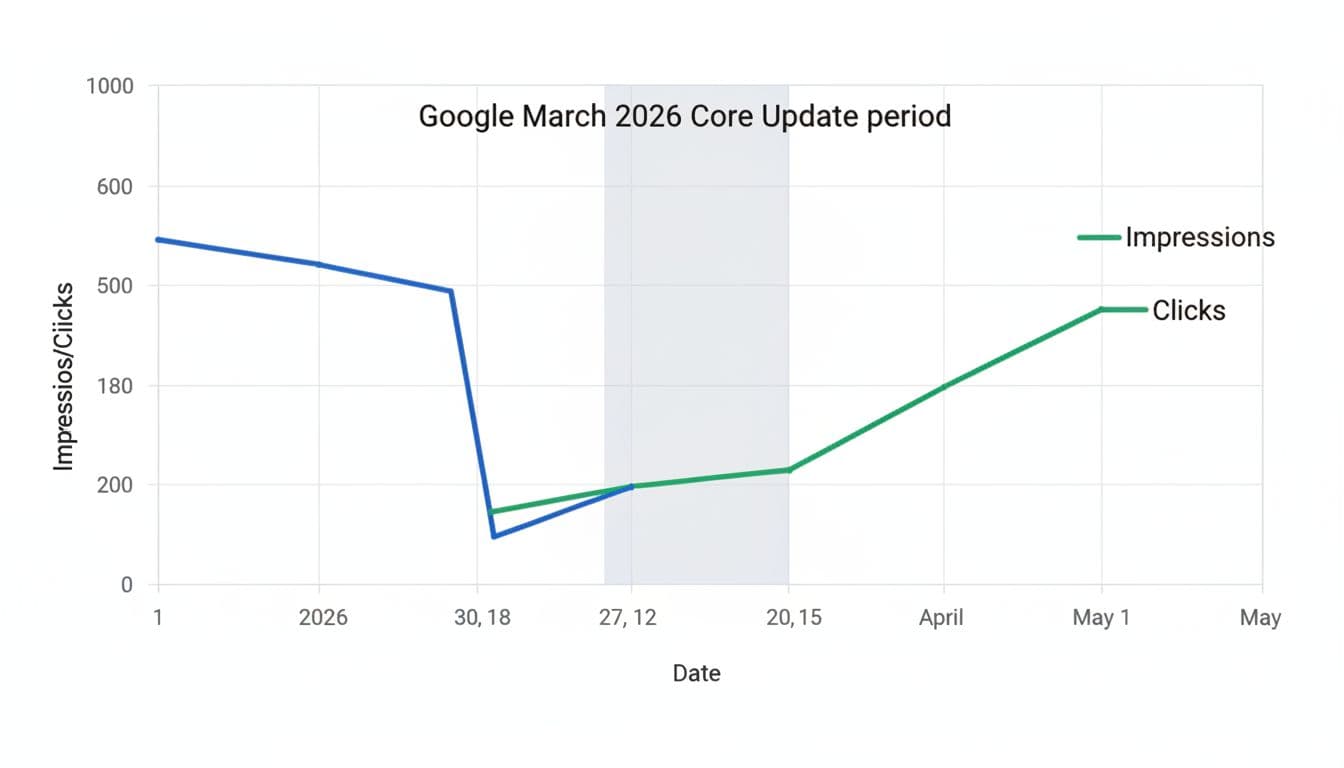
The sites affected by Google March 2026 update appear to share broad traits rather than one business model. Some publishers, affiliate-heavy sites, and high-volume content operations saw sharper movement. Meanwhile, some focused expert sites gained visibility. The key point is that volatility was uneven. A weak section could fall while a stronger section on the same domain stayed stable.
Common patterns among sites that lost visibility
Many weaker performers had several problems at once. They published scaled content with low original value. They covered topics far outside their core subject. Some pages had weak author credibility, poor mobile experience, or titles that promised more than the page delivered.
Timing also mattered. Because the March 2026 spam update landed right before the core update, some losses likely reflected both systems at work. That overlap made diagnosis harder. A site may have looked hit by the core update when spam-like tactics, thin affiliate pages, or template-heavy publishing were already creating risk.
What stronger-performing sites seemed to do better
The better-performing sites often showed tighter topical focus and better editing. They answered search intent clearly, without padding or vague filler. They also presented stronger E-E-A-T signals, especially where health, finance, or advice content was involved.
Several reviews, including this March 2026 recovery summary, pointed to similar patterns. Pages built for readers first, with original insight and visible trust signals, were more likely to hold or gain ground. That doesn't mean every winner was perfect. It means stronger pages gave Google more reasons to believe they were useful.
How to respond if your traffic dropped after the update
The hardest part of How to recover from Google core update 2026 is accepting that there is no quick fix. A broad update usually calls for better publishing choices, not panic edits. Recovery can happen, but it often takes weeks, months, or even another core update before Google fully re-assesses major changes.

Start with a clean review of your pages and search data
Begin with evidence, not guesses. Review the top losing pages, queries, devices, and countries in Search Console and analytics. Then compare the period before March 27 with the period after April 8. The phrase Google search ranking update March 2026 may sound like one event, but your losses may come from only one section or template.
Look for patterns. Did product reviews fall while guides stayed flat? Did mobile pages drop more than desktop? Did impressions hold while clicks fell, which may point to weaker snippets or poorer alignment with intent? A single ranking dip means little. A repeated pattern tells you where to act.
Build a smarter SEO strategy after the core update
A sound SEO strategy after Google core update 2026 starts with pruning confusion. Update weak pages that still deserve to exist. Merge overlapping posts that compete with each other. Add first-hand insight, clearer sourcing, and stronger author information where it fits. If a page says nothing new, either improve it sharply or remove it from the indexable set.
Technical issues also matter, though they rarely explain everything. Fix slow mobile pages, intrusive layouts, and clumsy navigation. Those changes can help in weeks. Larger content gains usually take longer because Google needs time to crawl, process, and compare the revised pages. The best recovery plans are patient, focused, and selective, not site-wide rewrites done in a weekend.
Google's March 2026 Core Update rewarded pages that felt more useful, more credible, and more clearly written for people. That is the central lesson. Chasing shortcuts after a broad update often makes things worse.
The better response is slower and more disciplined. Improve depth, originality, and trust where your site is weakest. When rankings move again, the sites that did the real work are usually the ones that stand up better.
Post a Comment
You can submit your blog and website with us @ free of cost. Go to this link Best Bookmarking Sites. Enjoy and Share!!!