
Data keeps a quiet diary of the world. Every purchase, missed appointment, traffic slowdown, and lab result leaves a trace. Data science is the work of turning those traces into useful answers people can act on. It doesn't start with fancy math, it starts with a question someone cares about.
This guide explains what data science is in simple terms, how it works step by step, and where it shows up in everyday life. You'll also learn the three main uses of data science, the 5 stages of a typical project, the 4 types of data science work, and what skills you need to get started.
Finally, we'll clarify how data science relates to AI, since people often mix them up.
What data science is and what problems it helps solve
Data science is a practical discipline that uses data, statistics, and computing to support decisions. In plain language, it takes messy facts and turns them into evidence. That evidence can explain what happened, forecast what's likely next, or suggest a better choice.
A helpful way to frame data science is through three main uses:
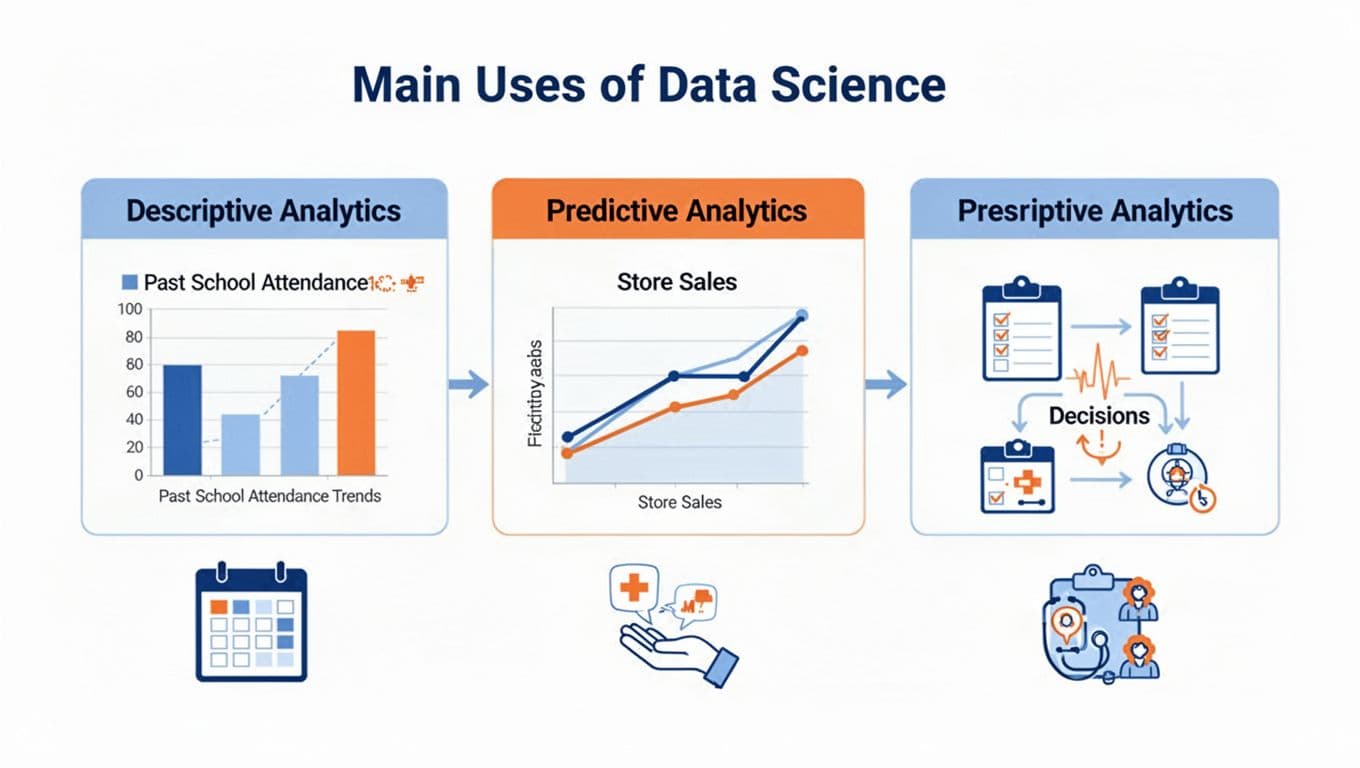
An overview of descriptive, predictive, and prescriptive uses of data science.
Descriptive (what happened). This summarizes the past.
Example: A school tracks attendance by grade and finds Mondays have the most absences.
Predictive (what will happen). This estimates the future using patterns from earlier data.
Example: A store uses past sales and seasonal trends to forecast next month's demand for winter coats.
Prescriptive (what to do next). This recommends actions, often by comparing options and constraints.
Example: A hospital uses predicted patient volume to adjust nurse schedules for the next week.
Data science can work with many kinds of data, not just spreadsheets. Common inputs include:
- Tables (sales, grades, budgets, survey results)
- Text (emails, support tickets, notes in a medical record)
- Images (X-rays, product photos, satellite imagery)
- Sensor data (heart rate, temperature, machine vibration, GPS)
Still, data alone isn't enough. Context gives meaning. A "missing value" might mean a broken sensor, or it might mean a customer skipped a question. If you treat those two cases the same way, your results can mislead.
What are data science examples you already see every day?
Many "smart" features are really data science helping someone make a better call.
Banks use fraud alerts to decide whether to block a card swipe or ask for extra verification. Online stores use product recommendations to decide which items to show first. Mapping apps optimize traffic or delivery routes, which helps decide the quickest path given congestion and road closures. In healthcare, patient risk flags can help decide who needs follow-up sooner, based on patterns in lab results and past visits.
In each case, the goal is similar: reduce guesswork. The details differ, but the logic stays the same, use past evidence to improve a decision you must make now.
How data science works, from messy data to a useful decision
Most projects follow a pipeline. People may use different names, but the 5 stages of data science usually look like this:
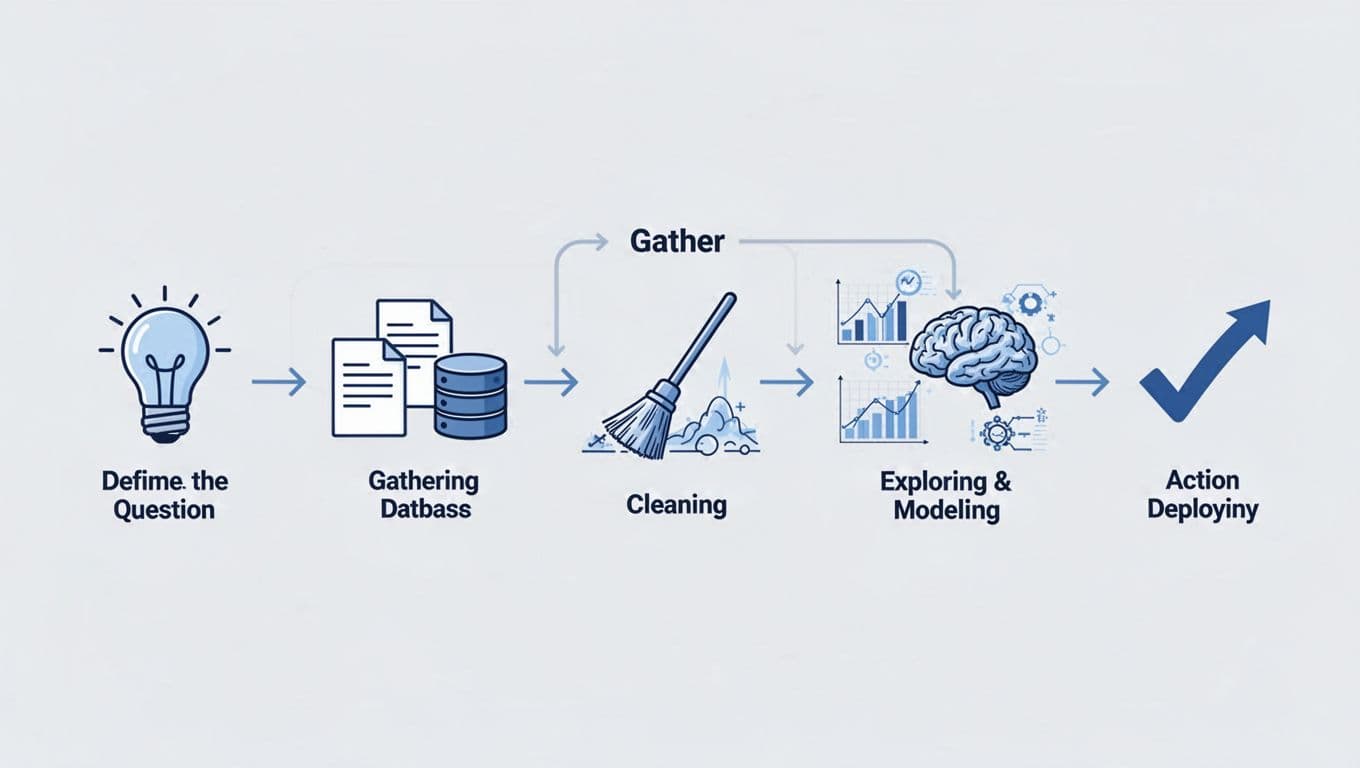
A simple pipeline view of how data science projects move from question to action.
- Define the question and success metric. Start with the decision. Then choose how you'll measure success. For example, if you want to predict next month's sales, decide whether "good" means low average error, fewer stockouts, or both.
- Gather data. Pull information from databases, spreadsheets, logs, surveys, or third-party sources. At this stage, you also check access rules, privacy limits, and whether the data covers the right time period.
- Clean and organize. Real datasets have missing values, duplicates, inconsistent labels, and outliers. A "NY," "New York," and "N.Y." might refer to the same state. For sales forecasting, you may also need to align calendar weeks, promotions, and product changes.
- Explore and model. Exploration means looking for patterns and sanity-checking assumptions. Modeling can be simple (averages, moving trends, regression) or more advanced (machine learning methods that learn complex patterns). A sales model might combine seasonality, price changes, and promotions.
- Test, explain, and put results into use. Testing checks whether the model holds up on new data. Explanation matters because people must trust the output enough to act on it. Deployment can be as small as a weekly report, or as integrated as an automated forecast feeding inventory orders.
A common surprise is how much time goes into cleaning and checking. If the input is wrong, the "smart" model only spreads errors faster.
One more point matters in 2026: data changes. Customer behavior shifts, hospitals change procedures, and fraud patterns adapt. Because of that, data science work often includes monitoring so models don't drift quietly out of date.
 Photo by Daniil Komov
The 4 types of data science work you might run into
People use "data science" as an umbrella term, so it helps to know the common categories.
Data analytics and reporting focuses on clear summaries of what happened, often for regular business tracking. Typical outputs include dashboards, weekly reports, and key performance indicators.
Statistics and experimentation tests cause and effect, such as whether a new app screen changes sign-ups. The output is often an A/B test readout, including confidence intervals and a recommendation.
Machine learning and predictive modeling builds forecasts or classifications from patterns in data. Common outputs include risk scores, demand forecasts, and models packaged for reuse.
Data engineering builds the pipelines that collect, store, and deliver clean data reliably. Outputs include well-defined datasets, automated data checks, and documented data tables that others can trust.
Skills you need, and how data science compares to AI
What skills are needed for data science? You need a mix of math sense, computing basics, and communication.
Start with basic statistics (averages, variation, correlation, probability). Pair that with clear thinking about questions, because a vague question leads to a vague result. Most roles also expect programming in Python or R, plus comfort with spreadsheets and SQL databases. Since cleaning is unavoidable, learn how to handle missing values, odd formats, and mismatched categories.
Communication matters as much as code. A useful data scientist can explain one chart in plain English and say what action it supports. Domain knowledge also matters, because "good" depends on the setting. A model that boosts sales might still be a bad idea if it harms safety or fairness.
Ethical work isn't optional. Privacy, consent, and bias checks protect real people, not just metrics.
People also ask, "Which is better AI or data science?" That's the wrong contest. AI is a set of tools that can learn patterns and automate tasks. Data science is the broader practice of using data to answer questions and support decisions, sometimes with AI, sometimes without it.
Here's a quick comparison:
| Area | Main focus | Typical output |
|---|---|---|
| Data science | Evidence for decisions (describe, predict, prescribe) | Insights, forecasts, recommendations |
| AI | Automation and machine behavior that adapts from data | Agents, classifiers, generative tools |
| Business intelligence | Past-focused reporting for operations | Dashboards and standard reports |
Free Data Science Courses Online at GalaxyonKnowledge
If you're searching for free data science courses online at GalaxyonKnowledge, treat your first course like a foundation, not a trophy. Look for lessons that teach statistics basics, data cleaning, and simple modeling, then require you to explain results in writing.
A strong beginner path usually includes a small project, such as cleaning a CSV file, building a basic forecast, and making one clear chart. Also check for practice with real datasets, since toy examples hide the hardest parts. If the platform offers quizzes or peer feedback, use them, because they force precision.
Conclusion
Data science turns raw data into practical answers for decisions. Its three main uses are descriptive (what happened), predictive (what will happen), and prescriptive (what to do next). Most projects follow the same 5 stages of data science: define the question, gather data, clean it, explore and model, then test and use the result.
If you're new, start small. Learn basic stats, practice cleaning one messy dataset, and explain one chart in plain English. With that, data science stops sounding abstract and starts feeling usable.
Post a Comment
You can submit your blog and website with us @ free of cost. Go to this link Best Bookmarking Sites. Enjoy and Share!!!